
Jackson County Court Records After a Jail Arrest
An arrest starts the process, but it does not set the charges in stone. After someone is taken into custody in Jackson County, they are booked at the Jackson County Correctional Facility on Penn Avenue in Marianna. The next stop is first appearance, where a judge reviews probable cause and may set bond. Then the prosecutor, the State Attorney for Florida's 14th Judicial Circuit, decides what to file. That filing opens a criminal case, and the case file becomes the court record that holds the formal charges, the case number, the hearing dates, and the disposition. So the court record after an arrest is the document that matters most when you want to know the true charges.
The arrest side and the court side hold different details. Booking data sits with the jail. For custody status, booking numbers, and how to confirm someone is held, see the jail inmate records page, and for booking photos see the jail roster mugshots page. The court record is separate. It is kept by the Jackson County Clerk of Circuit Court and tracks what the prosecutor actually charged. The charge written on a booking sheet at arrest can be amended, reduced, dropped, or replaced once the case is filed. That is why the court record, not the arrest paperwork, gives the reliable picture of charges after a Jackson County arrest.
How to Find Jackson County Court Records After an Arrest
Filed cases are searched through the Clerk, not through the jail. The official starting point is the Jackson County Clerk of Circuit Court court-search page at jacksonclerk.com/search-court-records. That page carries the disclaimers and the warrant notice, then links to the Civitek Online Court Records Search for Jackson County. Charges, charge codes, the case number, scheduled hearings, and disposition all show up in the court file once a case is filed. Arrest and booking detail does not. Keep the two apart so you know which channel answers your question.
The Clerk page links to the Civitek portal at civitekflorida.com/ocrs/county/32. The portal offers four ways in: Public, Attorney, Registered User, and Party Access. Public access is anonymous and free. The other three need a user ID and password and are meant for attorneys of record, registered users, or parties to a case. All online access runs under Florida AOSC 16-107. For most people checking charges after an arrest, the Public option is the right one.
The lead-in screen for the Clerk's court records is shown on the official Search Court Records page, which carries the disclaimer and the active-warrant warning before it hands you off to the portal.
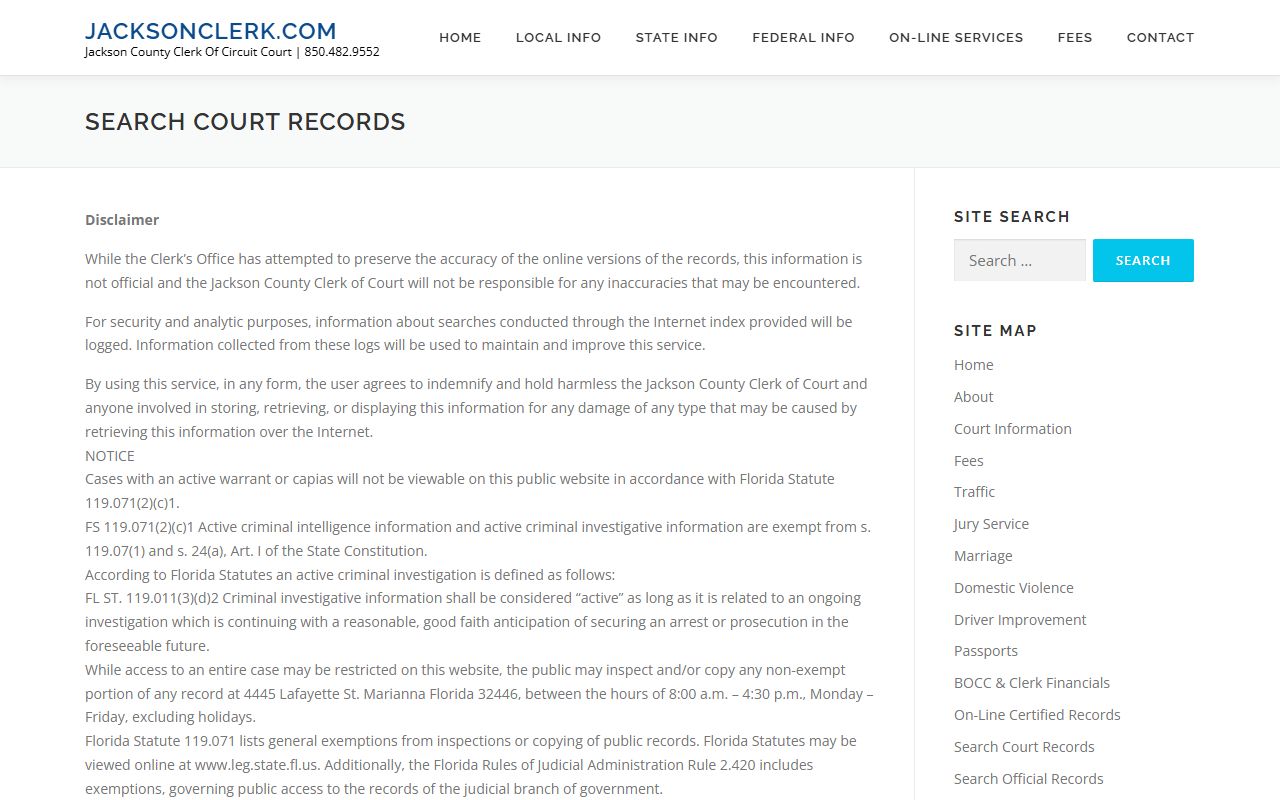
That page is where every Jackson County court record search after an arrest should begin, because it spells out that online copies are not official and that some cases are restricted from public web display. Read it first, then continue to the portal.
- Open the Clerk's Search Court Records page and read the disclaimer.
- Continue to the Civitek portal and choose Public for anonymous searching.
- Use the Person Search tab and enter the defendant's last name, or use the Case Search tab if you have a case number.
- Open the case and read each charge's code, level, and current status.
For a broader history, Florida keeps a statewide criminal-history repository. The Florida Department of Law Enforcement runs the official check at FDLE Florida Checks. FDLE dissemination of criminal-history information is governed by Florida Statutes section 943.053. A statewide check pulls records from across Florida, not just one county, so it can confirm whether an arrest led to charges that were filed elsewhere too.
Civitek Access Options for Jackson County Court Records
The access screen decides what you can see. When you land on the Jackson County Online Court Records Search, the portal first asks how you want to enter. Each choice maps to a different kind of user, and only Public is open to anyone without a login.
The four access buttons on the Jackson County Civitek portal are laid out on the entry screen below, which is the first thing a member of the public sees before agreeing to the terms.
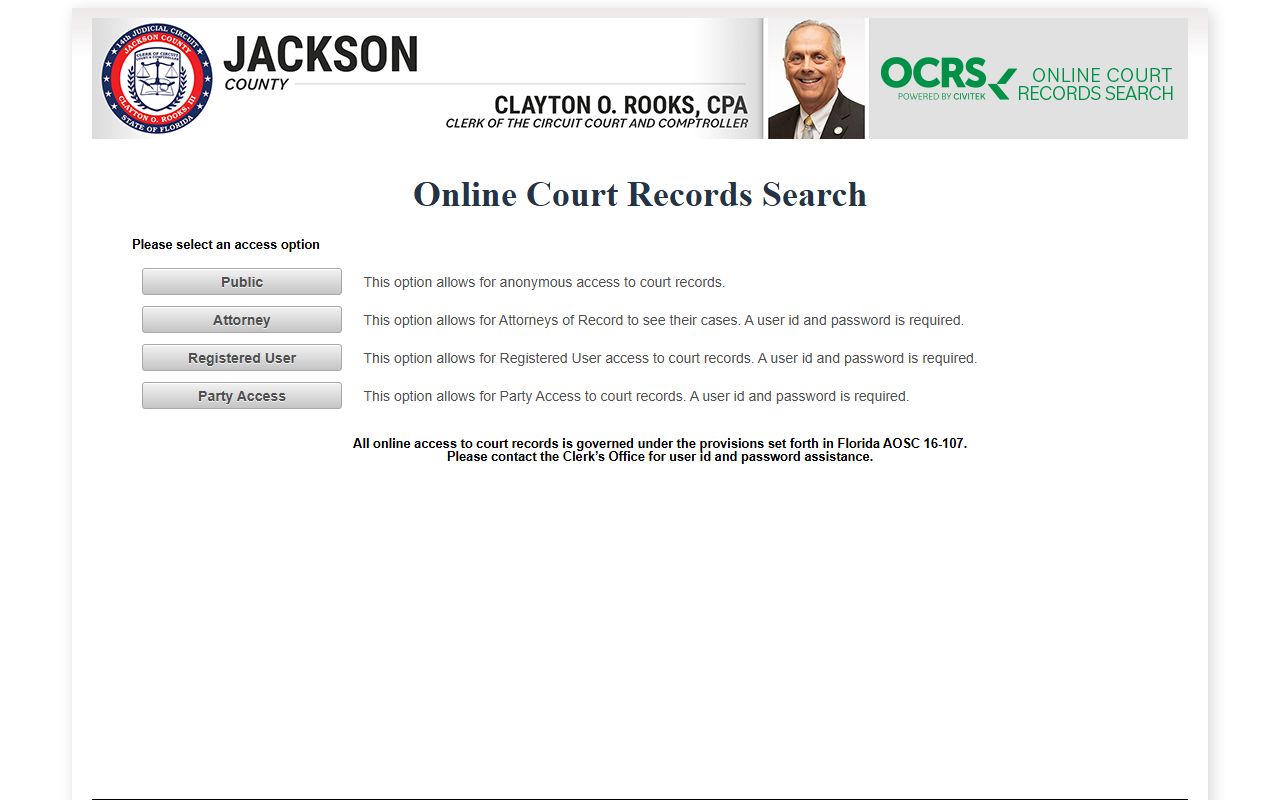
That screen is the gate to every public court record search for the county, so choosing Public and accepting the disclaimer is the normal route for anyone checking charges after an arrest.
| Access Option | Who It Is For | Login |
|---|---|---|
| Public | Anyone; anonymous access to court records | None |
| Attorney | Attorneys of record | User ID and password |
| Registered User | Approved registered users | User ID and password |
| Party Access | Parties to a case | User ID and password |
Once you choose Public and click I Agree, the portal opens a search form. You can search by person or by case. The Person Search tab is the practical choice when you only have a defendant's name from an arrest. Its fields are shown below.
| Field Label | Type | Required | Notes |
|---|---|---|---|
| Last Name | text | Required unless using business search | Person-name search. |
| First Name/MI | text | Optional | Narrows person-name results. |
| Business Name | text | Required if searching a business instead of a last name | Business-party search. |
| Date Case Filed From | date | Optional | Filing-date range start. |
| Date Case Filed To | date | Optional | Filing-date range end. |
| SSN | text | Optional, restricted | Sensitive identifier; use only if lawfully available. |
| Date Of Birth | date | Optional | Helps tell apart defendants with similar names. |
| Court type filters | checkboxes | Optional | Felony (CF), Misdemeanor (MM), Criminal Traffic (CT), and other division codes. |
| Buttons | buttons | n/a | Search, Reset. |
Note: The court type filters let you limit results to Felony (CF) or Misdemeanor (MM) cases when a common name returns too many matches to read.
How Charges Get Filed After an Arrest: Complaint, Information, and Indictment
The court record begins with a charging document. Booking at the jail records the arrest charges, but the formal court charge starts when the prosecutor or a grand jury files a charging document. Florida uses three main types, and which one appears in the file tells you how the case was charged. The State Attorney evaluates the arrest, the evidence, and the law, then chooses what to file or whether to file at all.
| Complaint | Information | Indictment | |
|---|---|---|---|
| Filed By | Officer or prosecutor | Prosecutor (State Attorney) | Grand jury |
| What It Is | A charging document or sworn allegation that starts a case in some contexts | The prosecutor-filed charging document common for Florida felony filings | A grand-jury charging document |
| Common For | Early or lower-level matters | Many felonies | The most serious felonies |
| Starts | The case | The case | The case |
The prosecutor here is the State Attorney for Florida's 14th Judicial Circuit, which serves Bay, Calhoun, Gulf, Holmes, Jackson, and Washington counties. The Marianna office sits at 4445 Lafayette Street, Room 201, and the phone is (850) 482-9555. The office site is sa14.fl.gov. The State Attorney represents the State of Florida and prosecutes the case, but the office generally cannot give legal advice to defendants. For legal advice, a defendant needs their own lawyer.
Charge Status in a Jackson County Court Record
Charges move as a case moves. The charge on a booking sheet at arrest is a starting point, and it can change once the case is filed. A prosecutor may amend a charge, reduce it to a lesser offense, or end it without a conviction. The court record shows the current status, which is why the case file is more reliable than the arrest paperwork. The terms below appear often in Florida criminal cases.
| Status | What It Means |
|---|---|
| Pending | The charge is filed but not yet resolved; the case is still moving. |
| Amended | The charge was changed from what was first filed or booked. |
| Reduced | A lesser charge was filed or accepted in place of the original. |
| Dismissed | The court or prosecutor ended the charge without a conviction. |
| Nolle Prosequi | The prosecutor decided not to proceed on the charge. |
| Disposition | The final outcome recorded for the charge or the case. |
Note: A booking charge from the jail can differ from the charge the prosecutor finally files, so always confirm the current charge in the court record rather than the arrest sheet.
Bond and Release After a Jackson County Arrest
Bond is usually addressed early. A judge often sets bond at first appearance, and the court docket controls many release conditions. The county jail does not publish a bond schedule online, so confirm any bond amount and any hold with the court, the Clerk, the jail, or a licensed Florida bail agent. To check custody status, call the Jackson County Correctional Facility at (850) 482-9651 and ask for Booking extension 218. To check the filed case, search the Clerk and Civitek court portal once the case appears. The table below outlines the main bond types in Florida.
| Bond Type | How It Works |
|---|---|
| Cash Bond | Money is posted directly for release if the court allows it. |
| Surety Bond | A licensed bail-bond agent posts the bond for a fee and a collateral agreement. |
| PR / Own Recognizance | Release on a promise to appear and meet set conditions, without full cash bond. |
| No-Bond Hold | The person cannot be released on that charge or hold until the court changes the status. |
A hold can keep someone in custody even after bond is posted. A detainer from another agency, a probation or parole issue, a federal warrant, or an immigration matter may block release. If a case is not visible online, it may not have been filed yet, it may be delayed, or it may involve active warrant or capias issues that are not shown on the public web. Do not trust anyone who demands bond payment through gift cards or apps. Verify with the official jail or Clerk number.
Warrants That Lead to a Jackson County Arrest
A warrant can turn into a booking. When officers arrest a person on an active warrant or capias, that person may be booked at the Jackson County Correctional Facility. The booking record may note a hold, a warrant number, the issuing agency, or bond status. The court record then tracks the case once charges are filed. No official Jackson County Sheriff's Office active-warrant search page was verified in the sources reviewed.
The Clerk gives the key warning for warrant cases. Cases with an active warrant or capias will not be viewable on the public website under Florida Statute 119.071(2)(c)1, because active criminal intelligence and active criminal investigative information are exempt from public inspection. A missing online result does not prove there is no warrant. The State of Florida does run a public option: the FDLE Wanted Persons Search at FDLE Wanted Persons. FDLE warns that wanted persons may use false identification and that results depend on what law-enforcement agencies enter. For sheriff-level routing, the administrative number from the FDLE directory is (850) 482-9624, while the jail line for a custody question is (850) 482-9651.
Inspecting Court Records in Person in Marianna
Some records do not show online but can still be inspected. The Clerk says that even where an entire case is restricted from web display, the public may inspect or copy any nonexempt portion in person. That inspection happens at the Clerk's office, 4445 Lafayette St., Marianna, FL 32446, from 8:00 AM to 4:30 PM, Monday through Friday, excluding holidays. This is the right channel for older records, restricted cases, or any file you cannot reach through the public portal.
Florida public-records policy starts from openness. Section 119.01 declares that state, county, and municipal records are open for inspection and copying unless an exemption applies, and section 119.07 governs how inspection and copying work, including permitted fees. The Clerk's online court records are not the official record, so an in-person copy is the way to get a certified or complete file when the case matters.
Charge vs Conviction in an Arrest Record
An arrest and a charge are not a conviction. A charge is an accusation that the court record shows once it is filed. A conviction comes only after a verdict or a plea. Both can appear in public court records, but they mean very different things. Reading a charge as guilt is a common mistake.
| Charge | Conviction | |
|---|---|---|
| Stage | Accusation after an arrest | Verdict or plea |
| Burden of Proof | Probable cause | Beyond a reasonable doubt |
| Meaning | The case is still open or unresolved | The court found or accepted guilt |
| Public Record | Yes, in the court file | Yes, in the court file |
Because a charge can be dismissed, reduced, or ended by nolle prosequi, the disposition field is the part of the court record that tells you how a charge actually finished. A charge alone says nothing about the outcome.
Sealed vs Expunged Arrest Records in Florida
Florida law lets some people clear a qualifying record after an arrest. Court-ordered sealing is governed by Florida Statutes section 943.059, and court-ordered expunction is governed by section 943.0585. The two are not the same. The table below shows the core difference.
| Sealed | Expunged | |
|---|---|---|
| Public Access | Hidden from public view | Record is destroyed or treated as if it never existed |
| Statute | Section 943.059 | Section 943.0585 |
| Eligibility | Set by Florida law for qualifying records | Set by Florida law; often tied to charges that were not filed, dismissed, or nolle prossed |
The process runs through FDLE and the court, not through any private website. FDLE explains the steps on its seal and expunge page, where it notes that a Certificate of Eligibility is the first step before petitioning the court, and that final relief requires a certified court order. For expunction, Florida law looks at whether an indictment, information, or other charging document was filed, dismissed, nolle prossed, or never filed, and FDLE requires a certified statement from the appropriate State Attorney. The State Attorney's seal-and-expunge information is on its official site.
Note: Sealing or expunction changes public access through the court and FDLE, so a private removal service cannot clear an official Jackson County court record.
Background Checks and Court Records
A casual court search is not a background check. Looking up a name in the Clerk's portal tells you what is filed in one county. A regulated background check pulls a wider record and follows the federal Fair Credit Reporting Act when it is used for credit, employment, housing, or insurance. The statewide FDLE criminal-history check is the official Florida source for a fuller record, and its dissemination follows section 943.053.
Important: This resource is not a consumer reporting agency under the FCRA, and nothing here may be used for credit, employment, housing, or insurance screening.
Restricted Court Records After a Jackson County Arrest
Not every record after an arrest is open. Florida law starts from openness, but exemptions apply, and several touch arrest and court records. Active criminal intelligence and active criminal investigative information are exempt under section 119.071, which is why active warrant and capias cases are hidden from the public web. Sealed and expunged cases, juvenile matters, victim identifying details, and certain court documents may also be withheld. Court-record access itself is governed by Florida Rule of General Practice and Judicial Administration 2.420, which the Clerk cites on its search page.
The practical takeaway is simple. If a case does not appear in the public portal, the reason may be timing, spelling, a sealed or restricted record, or an active warrant or capias. Confirm by inspecting nonexempt records in person at the Clerk's office in Marianna, or by directing charging questions to the State Attorney for the 14th Judicial Circuit, keeping in mind that prosecutors generally cannot give defendants legal advice.